
Headlamp battery life: what the hours on the box really mean
Headlamp battery life depends mostly on the brightness setting, the battery and the temperature. A figure such as up to 8 hours usually describes the best case. Look for hours listed per mode, charge between 32 and 105 degrees F, and keep a backup light.
 By Glenn Hartsock · Updated November 27, 2026Pen name. AI-generated illustration of an editorial pen name. Not a real person.
This site may earn a commission if you buy through links on the review page. It does not change what we recommend. Written from research, not hands-on testing.
What does the run time on a headlamp box mean?
It is how long the maker says the light runs under its own test conditions. An "up to" figure usually describes the longest case, often a low setting with a full, new battery. Without the level and method, you cannot compare it fairly.
So the first thing to look for is a table: hours on high, hours on medium, hours on low. One number for a light with several modes leaves you guessing.
Under the ANSI/PLATO FL 1 flashlight standard, run time starts with the output measured at 30 seconds and continues until the light reaches 10 percent of that value, as the standards group PLATO explains. A light can still be "running" while being far dimmer than when you switched it on.
Not every seller follows a standard. Ask which one they used, if any.
What makes a headlamp battery drain faster?
Brightness is the big one. Higher settings pull more power, so the light runs for less time. Cold weather, an aging battery and running extra emitters at once can also shorten a session. To pick a level, see how many lumens a headlamp needs.
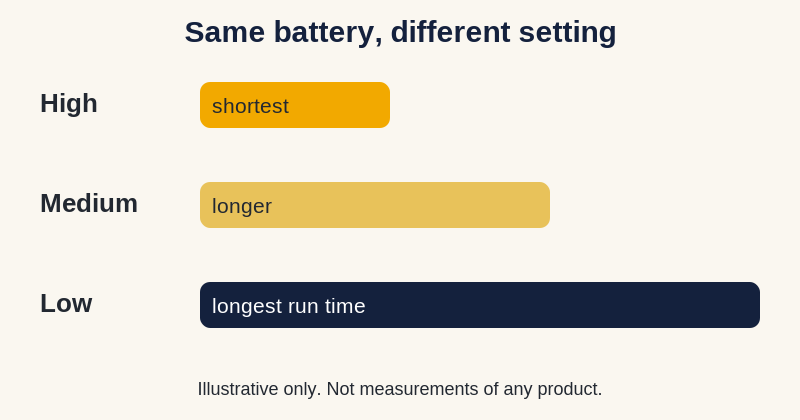
The guide by headlamp maker Petzl, published on OS Maps puts it plainly: brightness trades off against burn time, and using a lower setting when possible extends battery life. It also says many head torches have a reserve mode that leaves enough light to get home or change batteries.
Check whether yours has one before you need it. A light that simply goes out on a trail is a different experience from one that fades with warning.
Which battery type is better for a headlamp?
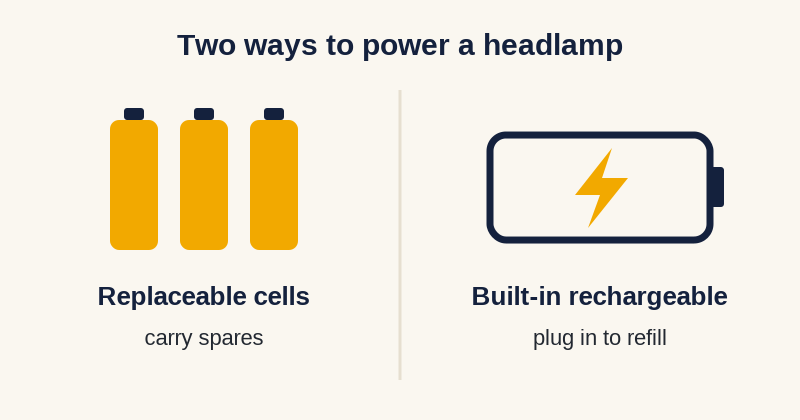
A built-in rechargeable battery is handy for frequent short use. Replaceable cells suit long trips or outages where you cannot plug in, since spares fit in a pocket. The best choice is the one you will actually keep ready.
According to the guide by headlamp maker Petzl, published on OS Maps, rechargeable models are more efficient than alkaline batteries, especially in cold conditions.
Battery capacity, often given in mAh, helps compare similar batteries at a similar voltage. It does not tell you run time on its own, because the light's draw matters just as much.
Also ask whether a built-in battery can be replaced. If it cannot, the life of the light ends when the battery wears out.
How should you charge a rechargeable headlamp safely?
Follow the manual, use the cable the maker supplies or recommends, charge on a hard surface where you can see it and unplug when full. Do not charge lithium-ion batteries in freezing or very hot conditions.
The U.S. Fire Administration page on battery fire safety says not to charge them below 32 degrees F (0 degrees C) or above 105 degrees F (40 degrees C). It also warns against leaving batteries in direct sunlight or hot cars.
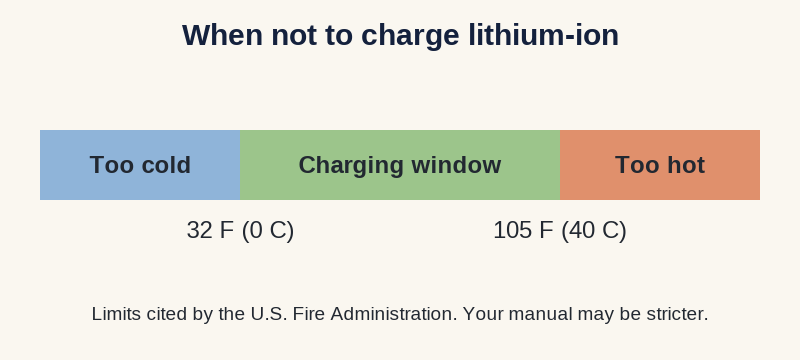
If your light lives in the truck, bring it in. Winter nights and summer dashboards both push past those limits.
Stop using the battery if you notice
- An unusual smell
- A change in color or shape, including swelling
- Heat beyond normal
- Leaking
- Odd noises
These are the warning signs listed by the U.S. Fire Administration. Set the device aside away from anything that burns, and contact the maker.
How can you check your own headlamp's run time?
Charge it fully, switch to the setting you use most, point it at a wall and note the start time. Check now and then while you are in the room. Stop when it is no longer bright enough for your task, and write down the hours.
This will not match a laboratory figure, and it does not need to. You are measuring what is useful to you.
Watch the light during the test. Do not leave it running or charging unattended, and stop if it gets unusually hot.
Repeat it once a season. If the hours drop a lot, the battery may be wearing out.
How do you read a battery claim before buying?
Look for hours per setting, battery type and capacity, charge time, port type and whether a cable is included. If the page gives only "up to" a number, write to the seller and ask at which level.
For example, on November 27, 2026 the LumenLight seller page said up to 8 hours of continuous use, with a charging cable included. A graphic in its product gallery listed 3 to 8 hours, a 4 hour full charge and a built-in 1200mAh battery, charged by USB-C. We did not find which light mode gives which run time.
These are seller figures. We have not used the product, so we have no run time of our own to offer.
For everything around the battery, from beam shape to water codes, start with how to choose a headlamp.
What should you do with an old headlamp battery?
Do not put a lithium-ion battery, or a device that contains one, in household trash or recycling bins. Take it to a certified electronics recycler, a retailer take-back program or a household hazardous waste collection point.
The EPA guidance on used lithium-ion batteries also advises taping battery terminals and bagging each battery or device separately, to help prevent fires. If a battery is damaged, contact the maker for handling instructions.
Your town or county website usually lists drop-off places. Call first to confirm they accept what you have.
Seller claims, what is not published, kit prices and return terms in one place. Research only: we have not used or tested the product.
Read the full reviewWhat else do people ask about headlamp batteries?
Most come down to charging and storage. Charge it where you can see it, keep it away from heat and cold, and check it before you need it.
How long should a headlamp battery last on one charge?
It depends on the setting and the battery. Look for hours listed for each mode and pick a light that covers your longest session with room to spare.
Can I leave my headlamp plugged in overnight?
It is safer to unplug it once it is full and to charge it where you can keep an eye on it. Follow your manual.
Does cold weather shorten battery life?
Cold can reduce what a battery delivers. Keep the light or spare batteries close to your body, and do not charge lithium-ion below freezing.
How often should I recharge a headlamp in storage?
Follow the manual. If it gives no interval, check the charge every few months and before storm season or a trip.
Can a built-in headlamp battery be replaced?
Some can and many cannot. Check the manual or ask the seller before buying, and do not open a sealed device yourself.
What does mAh mean on a headlamp?
It stands for milliamp hours, a measure of battery capacity. It does not give run time by itself, because power draw also matters.

Glenn Hartsock (pen name)
Glenn Hartsock is an editorial pen name. These guides are based on research of seller pages and public sources, not on hands-on testing.
Not a lab, an electrician, a safety expert or a medical professional. About the author and how we research
AI-generated illustration of an editorial pen name. Not a real person.
General information only. It is not safety, electrical or medical advice. Follow the manual that comes with your light, and ask a qualified professional about work that carries a risk of injury. Seller details can change after the date shown above.