
How many lumens for a headlamp? Match the number to the task
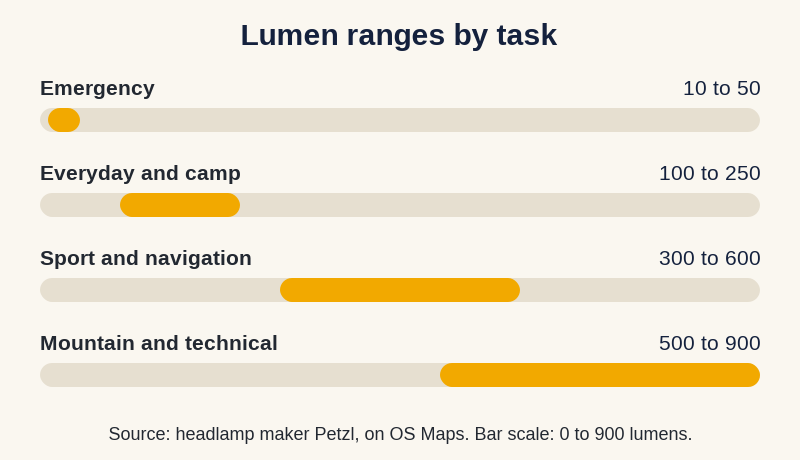
How many lumens a headlamp needs depends on the task. Headlamp maker Petzl suggests 10 to 50 for emergencies, 100 to 250 for everyday and camp use, 300 to 600 for outdoor sport and navigation, and 500 to 900 for technical mountain activity.
 By Glenn Hartsock · Updated November 27, 2026Pen name. AI-generated illustration of an editorial pen name. Not a real person.
This site may earn a commission if you buy through links on the review page. It does not change what we recommend. Written from research, not hands-on testing.
What does a lumen actually tell you?
A lumen measures how much visible light a source gives off. More lumens means more total light. NIST explains that lumens tell you how much light is put out in total. It does not tell you how far the beam goes, how even it looks or how long the battery will hold that level.
Two headlamps can share a lumen figure and behave very differently. One throws a tight circle down the trail. The other washes the whole workbench in soft light.
So read the number together with the beam shape and the run time. On its own, it is one third of the story.
How many lumens do you need for each task?
Headlamp maker Petzl suggests 10 to 50 lumens for emergencies, 100 to 250 for everyday and campsite use, 300 to 600 for outdoor sport and navigation, and 500 to 900 for mountaineering, technical trail running and skiing.
These figures are from the guide by headlamp maker Petzl, published on OS Maps. They are not a test of any particular light. Petzl sells headlamps, so read these as a maker's suggestion, not an official standard. We found no official source for ranges by task.
| Situation | Closest Petzl category | Suggested lumens |
|---|---|---|
| Finding the breaker box in an outage | Emergency use | 10 to 50 |
| Cooking at camp, reading a label | Everyday and campsite | 100 to 250 |
| Walking the dog on familiar streets | Everyday and urban | 100 to 250 |
| Finding a route off marked paths | Sport and navigation | 300 to 600 |
| Technical running or skiing in the dark | Mountain and technical | 500 to 900 |
The middle column is our matching of everyday situations to Petzl's categories. If you are between two, think about your eyes and your ground. Uneven footing is a reason to go up.
Is a brighter headlamp always better?
No. Higher output usually costs run time and can create glare on close, pale or wet surfaces. A light with useful low and middle settings serves most chores better than one with a single very bright mode.
Think of reading a parts diagram with the light on full. The page turns into a white square. Drop to low and the lines come back.
The same guide by headlamp maker Petzl, published on OS Maps notes that using a lower setting when possible extends battery life. That matters on a long outage night.
It also matters to whoever is next to you. A bright headlamp points wherever your face points, including straight into their eyes.
Why do two lights with the same lumens reach different distances?
Reach depends on how tightly the light is focused. A narrow beam sends its light farther. A wide beam spreads it over more area, so any one spot gets less. Distance also thins light quickly.
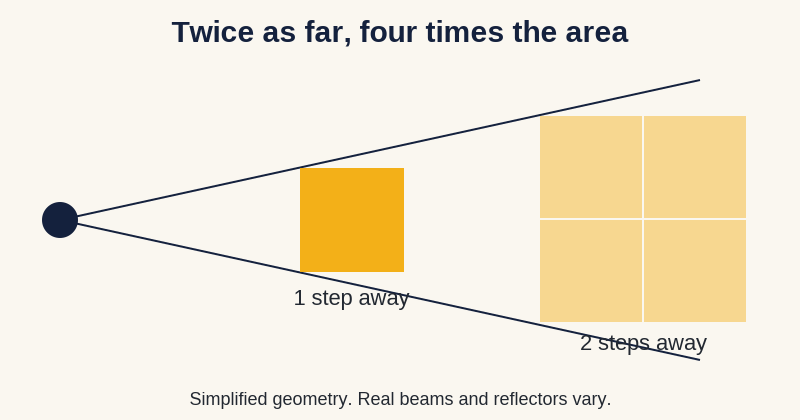
That is why a light that feels dazzling at the workbench can feel weak across a field.
A quoted beam distance is better read as the far edge of usefulness, not as a comfortable working range.
A wide strip across the forehead is built for width. A small round lamp with a reflector is built more for reach. Some headbands carry both.
Can you trust the lumen number on the box?
Trust it more when the listing names the mode and the measuring standard, and less when figures disagree or have no conditions. A peak number may only last a short time, so ask what the light does after the first minutes.
The flashlight industry has a standard, ANSI/PLATO FL 1. According to PLATO, on the 2025 edition, light output in standard modes is measured between 30 seconds and two minutes after switch-on, and boost modes between one and ten seconds. A light may well be dimmer an hour later.
A listing that does not mention any standard is not necessarily wrong. You just have less to go on.
One real case: on November 27, 2026, the LumenLight seller page at get-lumenlight.com listed 350 lumens in one section and 1200 lumens in another. A mode graphic in its gallery gave 350 lumens for each of the two lights at full power. We found no explanation for the larger number.
We have not tested that headlamp. If you are considering it, ask the seller which figure applies, and plan around 350 in the meantime.
Is 350 lumens enough for a headlamp?
Going by Petzl's ranges, 350 lumens sits above everyday and campsite use and at the lower end of sport and navigation. It would cover many close chores on paper. Whether a given light really reaches it is a separate question.
For repairs, outages and camp tasks, that is more than the suggested 100 to 250. You would likely run it on a lower setting much of the time, if the light offers one.
For fast movement on rough ground, the same Petzl guide goes up to 500 lumens and beyond. A wide beam at 350 is not a promise of long reach.
Cycling deserves its own care. Local rules on bike lights differ, and a headlamp worn on your head may not meet them. Check before relying on one.

How do you pick a brightness without testing lights in person?
Start with the range for your main task, then look for at least one setting below it and one above. Check the run time at the setting you expect to use most. Prefer listings that state conditions, and keep the return window in mind.
For the rest of the buying decision, from water codes to fit, see our guide on how to choose a headlamp.
For the other half of the brightness question, read about headlamp battery life.
When the light arrives, try it in a dark room and then outside while you can still return it. Look for even coverage, glare and a switch you can find without looking. Read the return conditions first, because some require the item to be unused.
Seller claims, what is not published, kit prices and return terms in one place. Research only: we have not used or tested the product.
Read the full reviewWhat else do people ask about headlamp lumens?
Most readers want to know if a number is enough. It depends on the task, the ground and the beam shape, and more light usually costs run time.
Is 100 lumens enough for a headlamp?
It is the lower end of the range headlamp maker Petzl suggests for everyday and campsite use. It is usually modest for fast movement on rough ground.
How many lumens for walking at night?
For everyday and urban use, headlamp maker Petzl suggests 100 to 250 lumens. Unlit, uneven ground may call for more.
How many lumens for night fishing?
Many close tasks fit the 100 to 250 everyday range. Use a low setting for knots, and check the water rating before taking any light near water.
Do more lumens drain the battery faster?
Usually yes. With the same battery and design, a brighter setting draws more power, so run time gets shorter.
Are lumens and beam distance the same thing?
No. Lumens describe total light. Beam distance describes how far useful light reaches, which depends on how the light is focused.

Glenn Hartsock (pen name)
Glenn Hartsock is an editorial pen name. These guides are based on research of seller pages and public sources, not on hands-on testing.
Not a lab, an electrician, a safety expert or a medical professional. About the author and how we research
AI-generated illustration of an editorial pen name. Not a real person.
General information only. It is not safety, electrical or medical advice. Follow the manual that comes with your light, and ask a qualified professional about work that carries a risk of injury. Seller details can change after the date shown above.