
How to choose a headlamp for the things you actually do after dark
To choose a headlamp, start with the job, then match brightness, beam shape, run time and water rating to it. For everyday and camp use, headlamp maker Petzl suggests 100 to 250 lumens. Before paying, check the return terms and whether the listing explains its numbers.
 By Glenn Hartsock · Updated November 27, 2026Pen name. AI-generated illustration of an editorial pen name. Not a real person.
This site may earn a commission if you buy through links on the review page. It does not change what we recommend. Written from research, not hands-on testing.
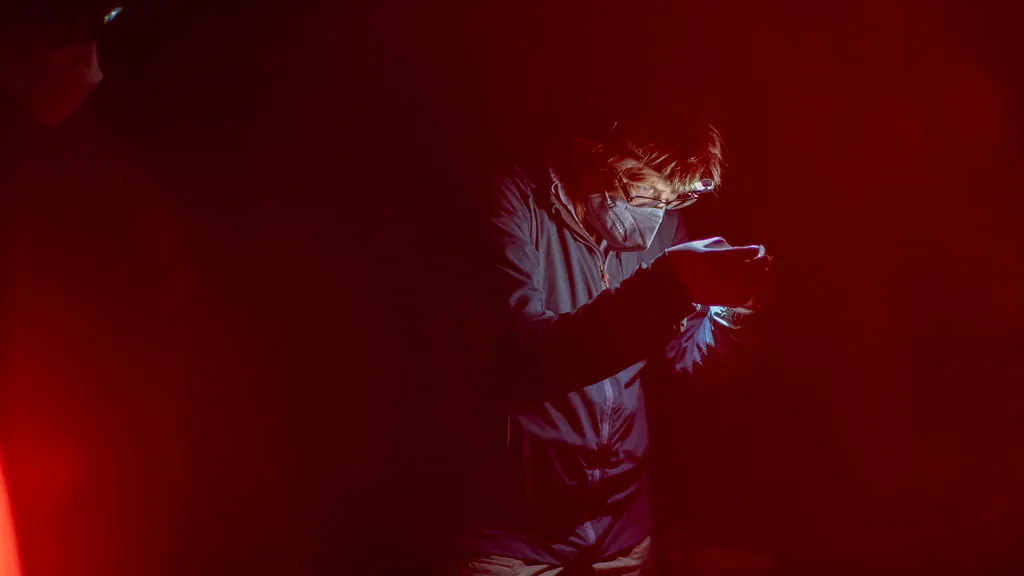
What should you decide before looking at any headlamp?
Decide the job first: where you will be, how far you need to see, how long the light must run and whether it will get wet. Those four answers remove most listings before you compare a single price.
Picture the real moment. Maybe it is the dog at 5 p.m. in January. Maybe it is a breaker box during an outage, or a hose clamp under the hood.
Each of those asks for something different. A repair wants soft, wide light up close. A dark lane wants some reach. A long evening at camp wants run time more than power.
Write it down in one line, like "close work and short walks, light rain, about two hours at a time". Keep that line next to you while you shop. It is the cheapest tool in this guide.
| Your job | What matters most | What matters less |
|---|---|---|
| Home repairs and outages | Wide even beam, low setting | Long reach |
| Evening walks | Some reach, comfort, being seen | Very high peak output |
| Camping | Run time, low mode, red light if you like it | Boost modes |
| Fishing at night | Water rating, hands-free switching | Maximum distance |
| Running and cycling | Reach, stable fit, proven output | Lowest price |
How bright does a headlamp need to be?
For everyday and campsite use, headlamp maker Petzl suggests 100 to 250 lumens. It suggests 300 to 600 for outdoor sport and navigation, and 500 to 900 for mountaineering or technical trail running.
Those ranges come from the guide by headlamp maker Petzl, published on OS Maps. Treat them as a starting point, not a rule. Petzl sells headlamps, so read these as a maker's suggestion, not an official standard. Your eyes, the weather and the ground all change what feels like enough.
A lumen is a measure of how much light comes out. It says nothing about where that light goes. A wide light and a narrow light can share a number and look nothing alike.
Also check whether the big number is a short boost. Some lights show their best figure on a mode you would not use for long. We break this down in how many lumens a headlamp needs.
When a listing shows two different brightness figures for one product, stop and ask. Plan around the lower one until someone shows you a label or a manual.
Which beam shape fits your task: flood or spot?
Choose flood for close work and spot for distance. Flood spreads light over a wide nearby area. Spot packs it into a narrow beam that travels farther. If you do both, look for a light that offers the two.
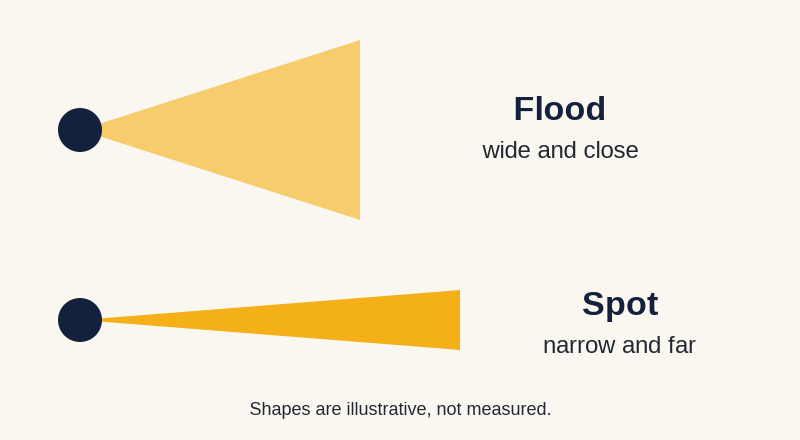
The same guide by headlamp maker Petzl, published on OS Maps says flood alone is enough for camp tasks or reading, while trail runners usually need both.
Wide-beam headband lights are common now, with a long strip across the forehead. Sellers often quote an angle, such as 230 degrees. An angle tells you about width. It does not tell you how bright the edges are.
Think about the people near you, too. A very wide, bright strip can shine into the face of whoever is standing beside you. Tilt the light down or use a low setting in a tent or a small room.
How long should the battery last?
Look for a run time that covers your longest session with room to spare, on the setting you will really use. A single "up to" figure usually describes the best case, which is often the lowest brightness.
Under the ANSI/PLATO FL 1 flashlight standard, run time starts with the output measured at 30 seconds and continues until the light reaches 10 percent of that value, as the standards group PLATO explains. A light can still count as running while it is much dimmer than at the start.
Ask the listing three questions. How many hours? At which level? Measured how? If only the first has an answer, treat the number as a hint.
The full explanation, with charging care, is in what headlamp battery life figures mean.
Is a rechargeable headlamp better than one with replaceable batteries?
Rechargeable is convenient if you can plug in often. Replaceable cells are handy when you are away from power for days, because you can carry spares. Some lights accept both, which gives you a fallback.
The guide by headlamp maker Petzl, published on OS Maps says rechargeable models are more efficient than alkaline batteries, especially in the cold, and that a spare pack is easy to carry.
With a built-in battery, the light is out of action when it is empty, unless it can run while connected to a power bank. Not every model can. Check the manual before you count on it.
Look at the charging port. Is it covered? Can you open the cover with cold fingers? Does the box include a cable? Small things, until the night you need them.
For outages, the Ready.gov page on power outages advises having flashlights for every household member and planning for backup power. A headlamp counts as one of those lights, as long as it is charged.
What do water resistance ratings on a headlamp mean?
An IP code describes how a product held up in a defined test. IPX4 covers splashes from any direction, IPX6 covers powerful jets, and IPX7 covers immersion up to one meter. The word "waterproof" alone does not tell you which test, if any.
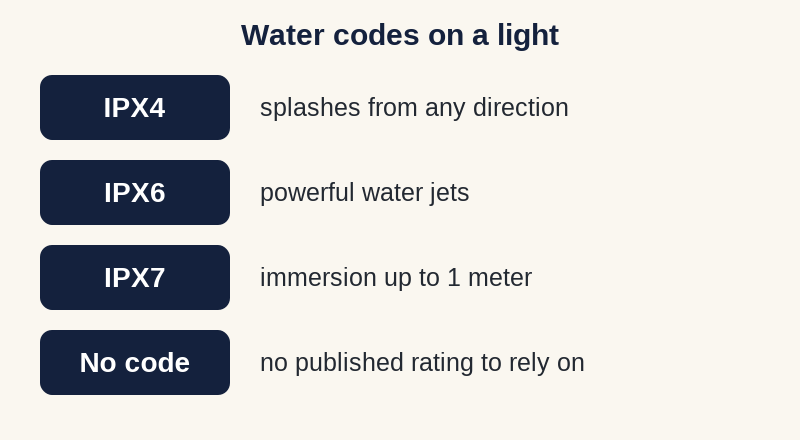
The guide by headlamp maker Petzl, published on OS Maps calls IPX4 the minimum water standard to consider. That is for splashes, such as ordinary rain on a walk.
The water tests behind these numbers are listed in the IEC 60529 standard preview published by NEMA: splashing for 4, a 12.5 mm nozzle for 6 and temporary immersion between 0.15 and 1 meter for 7.
A higher number on water is not a promise for every kind of water or every depth. Read what the seller says about use near water.
No published code? Then plan as if the light should stay dry, and keep it away from sinks, buckets and the side of the boat.
How do comfort and controls change the choice?
A headlamp you take off after ten minutes is not helping. Check weight, band adjustment and how the switch works with wet or gloved hands. These details decide whether the light gets used or stays in a drawer.
Weight in grams is worth looking for. "Lightweight" is an opinion until there is a number. The same goes for "comfortable".
Think about what you wear. A beanie, a cap or a hood changes how a band sits. A wide front strip may rest differently from a small lamp on a swivel.
Some headlamps have a motion sensor, so a wave of the hand turns the light on and off. That is useful with dirty or full hands. It is also fair to ask whether a branch, a hat brim or a fishing rod can trigger it, and whether you can switch the sensor off.

A red mode is another small extra. The same Petzl guide describes it as kinder to the eyes and less likely to wake a tent companion.
How can you tell whether a listing is trustworthy?
Read for numbers with conditions: brightness with a mode, run time with a level, water resistance with a code, weight in grams. Then check the return terms and the final total before paying. Missing details are information too.
An example of where to look: on November 27, 2026, graphics in the LumenLight product gallery at get-lumenlight.com listed an IPX4 water code, a weight of 100 g and a built-in 1200mAh battery charged by USB-C.
Those are the seller's figures. We have not measured or tested them. Find the same kind of detail for any light you compare, and ask the seller about whatever is missing.
Questions worth asking before you buy:
- Which brightness figure belongs to which mode?
- What level gives the quoted run time?
- Which water code applies?
- What does a return require, and who pays the shipping back?
- Are there add-ons selected at checkout?
A research review of the seller claims, the open questions and the return terms. We have not tested the product.
Read the full reviewWhat mistakes do people make when buying a headlamp?
The usual ones are buying by the biggest number, ignoring run time, trusting "waterproof" without a code and skipping the return policy. Each is easy to avoid with two minutes of reading.
Chasing lumens. A very high figure may drain the battery sooner and glare off a white page or a wet road. For close work, a lower setting is often more pleasant.
Counting on one light. Keep a second source around. A small flashlight in a kitchen drawer is cheap insurance on an outage night.
Forgetting to be seen. A headlamp helps you see. Near traffic, you also want drivers to see you from the side and from behind, so add reflective material.
Assuming a job rating. A consumer headlamp is not automatically fit for a job site, a rescue or a flammable atmosphere. Those need equipment certified for the purpose.
Putting it away empty. Charge after use, and check it before storm season or a trip.
Which headlamp features matter for walks, outages, repairs and camping?
Walks reward comfort and a bit of reach. Outages reward long run time on low. Repairs reward wide, even light you can angle. Camping rewards a gentle low mode and a charge that lasts the whole trip.
Night walks with a dog
You have a leash in one hand and, sooner or later, a bag in the other. A switch you can work without fumbling helps. So does a band that stays put when the dog pulls.
Point the light a few steps ahead, not into the faces of people coming the other way. Dip your head or drop the level when you pass someone.
Power outages
Here you want modest light for a long time. Low mode is usually plenty for stairs, a fuse panel or a can opener. Store the headlamp in one fixed spot that everyone at home knows.
Check it on a calendar date you will remember, such as when the clocks change. A light found with a flat battery is only a headband.
Repairs at home and on the car
Under a sink or a hood, you work inches from the part. A very high setting can bounce off metal and tire your eyes. Start low and go up as needed.
Light does not make a job safe on its own. Support a raised car properly, switch off power at the breaker for electrical work, and call a professional when the task is beyond you.
Camping and fishing
Think about how many evenings you will be out and whether you can recharge. Water is the other question, since boats, banks and dew all get things wet. A power bank helps only if you pack it charged and the cable fits.
How do you look after a headlamp so it is ready when you need it?
Wipe it dry, charge it after use, store it at room temperature and check it every few months. Stop using any light whose battery swells, smells odd or gets unusually hot, and follow the maker's instructions for charging.
Close the port cover firmly before it goes out in the rain. Water that reaches a charging port is a poor way to learn what the seller meant by "waterproof".
Rinse the band by hand if it gets salty or muddy, and let it air dry before storing. Do not dry it on a heater or a dashboard.
Keep the manual, the order confirmation and the box for as long as the return window is open. Some return policies ask for the original packaging.
When the light reaches the end of its life, do not throw a device with a built-in lithium battery in the household trash. The article on battery life explains where it can go.
What is a quick checklist before you buy?
Match brightness to the job, pick the beam shape, confirm run time at a usable level, look for a water code, check weight and controls, and read the return terms. If three of those are blank, keep looking or ask first.
| Check | Good sign | Warning sign |
|---|---|---|
| Brightness | One figure per mode | Two figures that disagree |
| Run time | Hours listed for each level | Only "up to" |
| Water | An IP code | Only the word "waterproof" |
| Charging | Port type and charge time listed | No details |
| Returns | Conditions written plainly | Slogans with no policy |
| Price | Total shown with shipping | Countdown timers |
Take a screenshot of the listing and the return page on the day you order. If something differs later, you will have the wording you agreed to.
Seller claims, what is not published, kit prices and return terms in one place. Research only: we have not used or tested the product.
Read the full reviewWhat else do people ask about headlamps?
Most come down to brightness, fit and water. A first headlamp should match your main task, switch easily and stay charged. The short answers are below.
How many lumens should a first headlamp have?
For everyday and campsite use, headlamp maker Petzl suggests 100 to 250 lumens. Pick more only if you need distance or do outdoor sport.
Is a wide beam better than a narrow beam?
Neither wins every time. Wide light suits close work and camp chores. A narrow beam reaches farther along a path.
Is IPX4 enough for rain?
IPX4 covers splashes from any direction and is the minimum headlamp maker Petzl suggests. It does not cover dunking the light.
Can I wear a headlamp over a hat?
Often yes, if the band adjusts enough. Check that the hat does not block the lamp or trigger a motion sensor.
Are motion sensor headlamps worth it?
They help when your hands are full or dirty. Check whether the sensor can be turned off to avoid accidental switching.
Should I keep a headlamp for power outages?
Yes, it is a practical choice. Keep it charged, store it where you can find it in the dark and have a backup light.

Glenn Hartsock (pen name)
Glenn Hartsock is an editorial pen name. These guides are based on research of seller pages and public sources, not on hands-on testing.
Not a lab, an electrician, a safety expert or a medical professional. About the author and how we research
AI-generated illustration of an editorial pen name. Not a real person.
General information only. It is not safety, electrical or medical advice. Follow the manual that comes with your light, and ask a qualified professional about work that carries a risk of injury. Seller details can change after the date shown above.